Showing posts with label red. Show all posts

Wednesday, May 23, 2012

FFF13 - DAUGHTER OF THE WIND

Anemone ( /ənɛˈməniː/), is a genus of about 120 species of flowering plants in the buttercup family Ranunculaceae in the north and south temperate zones. They are closely related to Pasque flowers (Pulsatilla) and Hepaticas (Hepatica); some botanists include both of these genera within Anemone. The name of the flower is from the Greek ἀνεμώνη (anemōnē) which means "daughter of the wind", from ánemos "wind" + feminine patronymic suffix -ōnē.


Here is an Anemone coronaria succumbing to the wind.


Please join me for Floral Friday Fotos by linking your flower photos below, and leave a comment once you have done so!


FFF17 - BLOOD FLOWER

Haemanthus coccineus (commonly known as the Blood Flower or Paintbrush Lily), is a bulbous geophyte in the genus Haemanthus, native to Southern Africa. The generic name Haemanthus is derived from the Greek words haima for "blood" and anthos for "flower"; coccineus is the Latin word for red or scarlet. In the Afrikaans language it is known as Bergajuin, Bloedblom, and many other vernacular names.

The Blood Lily is native throughout the winter rainfall region in Southern Africa - from the southern parts of Namibia, to South Africa in the Cape Peninsula, to the Keiskamma River in the Eastern Cape. It is an adaptable species, growing in a wide range of soils derived from sandstones, quartzites, granites, shales and limestones. It will survive annual rainfall ranging from 100–1,100 millimetres.

The large (up to 10 cm diameter) flowerheads of Haemanthus coccineus emerge between February and April in the Southern Hemisphere, with scarlet spathe valves on them like bright shaving brushes, making it a striking plant. The flowers are soon followed by translucent, fleshy berries. There are usually two very large leaves per bulb, and occasionally three, these leaves appearing only after flowering has occurred. We have it growing in our garden quite happily and it always attracts a lot of attention when it is in bloom.

Please join me for Floral Friday Fotos by linking your flower photos below, and please leave a comment once you have done so!


FFF24 - THE "GOLDEN FLOWERS"

Chrysanthemums, often called mums or chrysanths, are of the genus Chrysanthemum, comprising approximately 30 species of perennial flowering plants in the family Asteraceae which is native to Asia and northeastern Europe. The name chrysanthemum was given tot hese plants by Linnaeus and is derived from the Greek words, chrysos (golden) and anthemon (flower), with many of the cultivated varieties having brilliant yellow-gold flowers.

Chrysanthemums were first cultivated in China as a flowering herb as far back as the 15th century BC. The plant is renowned as one of the "Four Gentlemen" in Chinese and East Asian art. The plant is particularly significant during the Double Ninth Festival. It is believed that the flower may have been brought to Japan in the 8th century CE, and the Emperor adopted the flower as his official seal. There is a "Festival of Happiness" in Japan that celebrates the flower. The flower was brought to Europe in the 17th century.

Modern chrysanthemums are much more showy than their wild relatives. The flowers occur in various forms, and can be daisy-like, decorative, pompons or buttons. This genus contains many hybrids and thousands of cultivars developed for horticultural purposes. In addition to the traditional yellow, other colors are available, such as white, purple, and red. The most important hybrid is Chrysanthemum × morifolium (syn. C. × grandiflorum), derived primarily from C. indicum but also involving other species. The photo here is from a plant in our garden, which was given to us as a cutting by a neighbour. It currently has a profuse showing of rich, large blossoms that brighten the wet and gray autumn days.

Join me for Floral Friday Fotos by linking your flower photos below, and please leave a comment once you have done so!

FFF26 - THE WARATAH

Telopea speciosissima or the “waratah” is a native Australian plant with spectacular flowers. Robert Brown (1773-1858) named the genus Telopeain 1810 from specimens collected in the Blue Mountains, west of Sydney. Sir James Smith (1759-1828), a noted botanist and founder of the Linnaean Society in England, wrote in 1793: 'The most magnificent plant which the prolific soil of New Holland affords is, by common consent, both of Europeans and Natives, the Waratah. It is moreover a favourite with the latter, upon account of a rich honeyed juice which they sip from its flowers'.

The generic name Telopea is derived from the Greek 'telopos', meaning 'seen from afar', and refers to the great distance from which the crimson flowers are discernible. The specific name speciosissima is the superlative of the Latin adjective 'speciosus', meaning 'beautiful' or 'handsome'. 'Waratah', the Aboriginal name for the species, was adopted by early settlers at Port Jackson.


Telopea is an eastern Australian genus of four species. Two are confined to New South Wales, one to Tasmania and one extends from eastern Victoria into New South Wales. Telopeabelongs to the family, Proteaceae, which is predominantly Australian and southern African. The Waratah is a stout, erect shrub which may grow to 4 metres. The dark green leathery leaves, 13-25 cm in length, are arranged alternately and tend to be coarsely toothed. The flowers are grouped in rounded heads 7 to 10 cm in diameter surrounded by crimson bracts, about 5 to 7 cm long. It flowers from September to November and nectar-seeking birds act as pollinators. Large winged seeds are released when the brown leathery pods split along one side.

The species is fairly widespread on the central coast and adjoining mountains of New South Wales, occurring from the Gibraltar Range, north of Sydney, to Conjola in the south. It grows mainly in the shrub understorey in open forest developed on sandstone and adjoining volcanic formations, from sea level to above 1000 metres in the Blue Mountains. Soils within its range tend to be sandy and low in plant nutrients. Rainfall is moderately high. Waratah plants resist destruction by bushfires, a natural element of their habitat, by regenerating from the rootstock. Flowering recommences two years after a moderate fire.

The Waratah is a spectacular garden subject in suitable soil and climate; it flowers prolifically and tends to be long-lived. The Waratah occurs naturally in at least ten national parks in the geological formation, know as the Sydney Basin. Brisbane Water, Dharug and Macquarie Pass National Parks are among the areas where this species is conserved. Waratahs are cultivated north of Sydney and in the Dandenong Ranges, Victoria. They are grown in Israel, New Zealand and Hawaii for the cut flower trade. It was introduced to England in 1789 but cannot survive English winters out of doors except in the south-west coastal regions, and it rarely flowers in glasshouses. It is also cultivated in California.

Join me for Floral Friday Fotos by linking your flower photos below, and please leave a comment once you have done so!


Wednesday, August 19, 2009

Noble Rot - Get Up Here!

More from my Portland Oregon trip. Portland is known for being "different" and many Portland folks I know pride themselves in being weird. It isn't only the people that are weird.

This restaurant is called Noble Rot and the sign says Get Up Here! Its on the top floor of a large building.

Noble Rot - Get Up Here

The building itself is beautiful and fascinating. It takes up a big part of a block and the windows all around the building have this art work. It looks like it could be an apartment building. I love the building but it makes me wonder if the occupants are ok with the windows being mostly blocked by the art.

Window Art

Wednesday, July 29, 2009

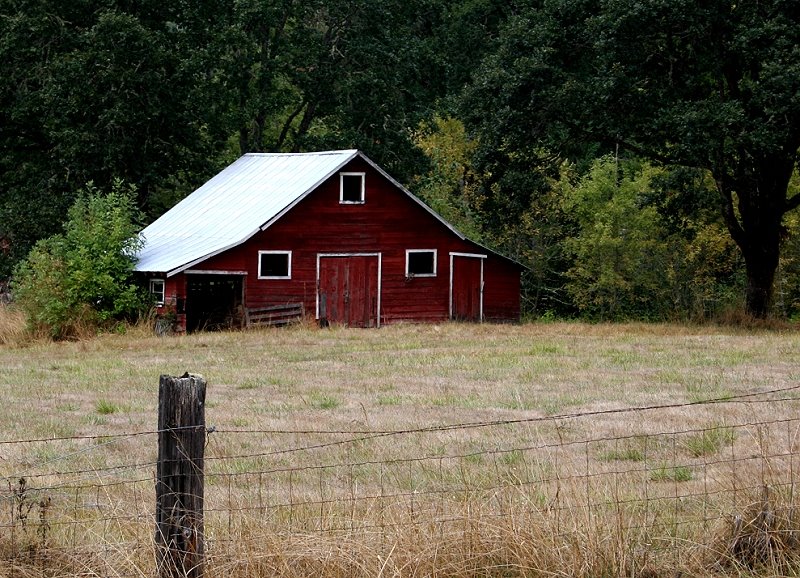
Florney Valley Red Barn

I have posted this red barn before, but not with this tall grass.

Florney Valley Red Barn

This is a post from Oct 2006. I see they cut down the bush on the left and traded the wood fence post for metal. I much prefer the wood but I'm sure the new one will last much longer.


It was 108 here yeaterday. That is almost unheard of for this area. It only got to 103 today. Sheesh! I am not loving this heat wave. But then I work in a nice cool office and have a nice cool home.

I am concerned about of the homeless folks in the area. They are warning people to stay indoors out of the heat, but when you have no "indoors" thats pretty hard. Yesterday some of the staff where I work took a van around with cold water, ice and sun screen to pass out to anyone they found needing some relief. They will continue to do this as long as this heat wave lasts.

I'm headed up to Salem for a meeting tomorrow and will be back Friday evening. I'm hoping for a greatly air conditioned meeting room and hotel room.

Wednesday, November 26, 2008

Wet Smoke Bush

My husband planted a smoke tree in the back yard last year. So far its still a smoke bush because it isn't very big but it had beautiful red leaves this fall.

Wet Smoke Bush

Tuesday, October 2, 2007

OK.. the Mirror Reflection photo WAS flipped. I thought one of you would figure it out from the moss on the left side :)

Still at Shore Acres...

This plant fascinated me. The "fruit" looks like rose hips but they are HUGE... probably the size of a US quarter across. But if they are rose bushes there were no faded flowers left anywhere on the plant and it seemed like there should have been. Anyone know what this is?

Rose Hips

Rose Hips 2