Showing posts with label macro. Show all posts

Wednesday, May 23, 2012

FFF9 - MAGNOLIA GRANDIFLORA

Magnolia grandiflora is an evergreen tree which grows to a height of 10m and a width of 10m, native to South-eastern N. America - North Carolina to Florida and Texas. It has a moderate growth rate. In Australia, Magnolia grandiflora will flower in December to March with the seeds ripening from March to May. The large, showy, fragrant white flowers from this plant are hermaphrodite (both male and female reproductive organs) and they are pollinated by beetles.

The name magnolia was coined in recognition of Pierre Magnolia, the French Botanist (1638-1715). Magnolias are considered to be an ancient flowering plant bearing the largest individual flowers of any tree or shrub that can be cultivated in temperate climates.

Please join me for Floral Friday Fotos by linking your flower photos below.


FFF17 - BLOOD FLOWER

Haemanthus coccineus (commonly known as the Blood Flower or Paintbrush Lily), is a bulbous geophyte in the genus Haemanthus, native to Southern Africa. The generic name Haemanthus is derived from the Greek words haima for "blood" and anthos for "flower"; coccineus is the Latin word for red or scarlet. In the Afrikaans language it is known as Bergajuin, Bloedblom, and many other vernacular names.

The Blood Lily is native throughout the winter rainfall region in Southern Africa - from the southern parts of Namibia, to South Africa in the Cape Peninsula, to the Keiskamma River in the Eastern Cape. It is an adaptable species, growing in a wide range of soils derived from sandstones, quartzites, granites, shales and limestones. It will survive annual rainfall ranging from 100–1,100 millimetres.

The large (up to 10 cm diameter) flowerheads of Haemanthus coccineus emerge between February and April in the Southern Hemisphere, with scarlet spathe valves on them like bright shaving brushes, making it a striking plant. The flowers are soon followed by translucent, fleshy berries. There are usually two very large leaves per bulb, and occasionally three, these leaves appearing only after flowering has occurred. We have it growing in our garden quite happily and it always attracts a lot of attention when it is in bloom.

Please join me for Floral Friday Fotos by linking your flower photos below, and please leave a comment once you have done so!


FFF25 - THE SWEET-SCENTED JASMINE

Jasminum, commonly known as jasmines, is a genus of shrubs and vines in the olive family (Oleaceae). It contains around 200 species native to tropical and warm temperate regions of the Old World. Jasmines are widely cultivated for the characteristic fragrance of their flowers.

Jasminum angulare (Wild Jasmine) is a species of jasmine that is indigenous to South Africa. This scrambling climber can be grown in the sun or semi-shade. It produces masses of white, scented, star-shaped flowers and it attracts a variety of birds. This is one of around 10 species of Jasmine that naturally occur in South Africa.

Join me for Floral Friday Fotos by linking your flower photos below, and please leave a comment once you have done so!


Sunday, December 4, 2011

FFF3 - BEE ON LAVENDER FLOWER

Italian lavender (Lavandula pedunculata) is very attractive to bees and photographing the interaction of bee and flower is always rewarding!

Please join us and share your flower photos every Friday!


Sunday, November 27, 2011

FFF2 - JAPANESE WATER IRIS

Iris ensata (Japanese Water Iris) is a perennial which grows to a height of 0.6m and a width of 1m. It is vunerable to frost, so does best in milder climates. Japanese Water Iris will flower in November to January. The flowers from this plant are hermaphrodite (has both male and female organs) and they are pollinated by insects.

This macro shot shows the intricacy of the centre of the flower and the beautiful colours.

Please join us and share your flower photos every Friday!


Tuesday, March 6, 2007

Playing With Daisies

I Just had a few minutes to grab a shot this afternoon so I went out to the yard and picked a small daisy. I haven't used my macro lens for awhile so stuck the daisy stem in a hole in my fence to get a few close up shots. The flower head is about a half inch across.

I decided to try something I have heard others talk about but have never tried myself. I reversed the lens on my camera, holding it in place while shooting. You can get an attachment that will hold the lens in place but I don't have one.

I didn't use a tripod and trying to hold the lens in place and focus was quite a challenge so the images aren't sharp but I was amazed at how much closer you can get using this method.

daisy3

And then, of course, I had to play with them in Paint Shop Pro and Photoshop.

daisy1

I used another daisy with a little pink on it for this extra close shot.

daisy close

I'll be trying this experiment again.

Saturday, November 4, 2006

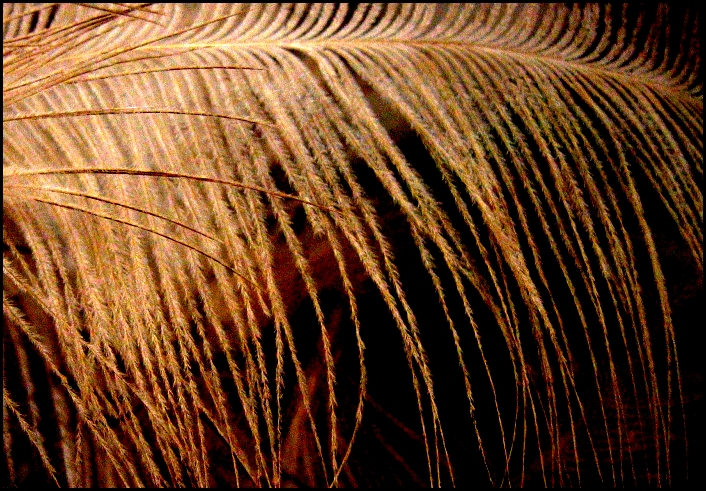
Feathers

I'm lazy and haven't downloaded the photos I took today so this is a repeat of the one I posted on the 30 Day Macro Challenge on DPC.